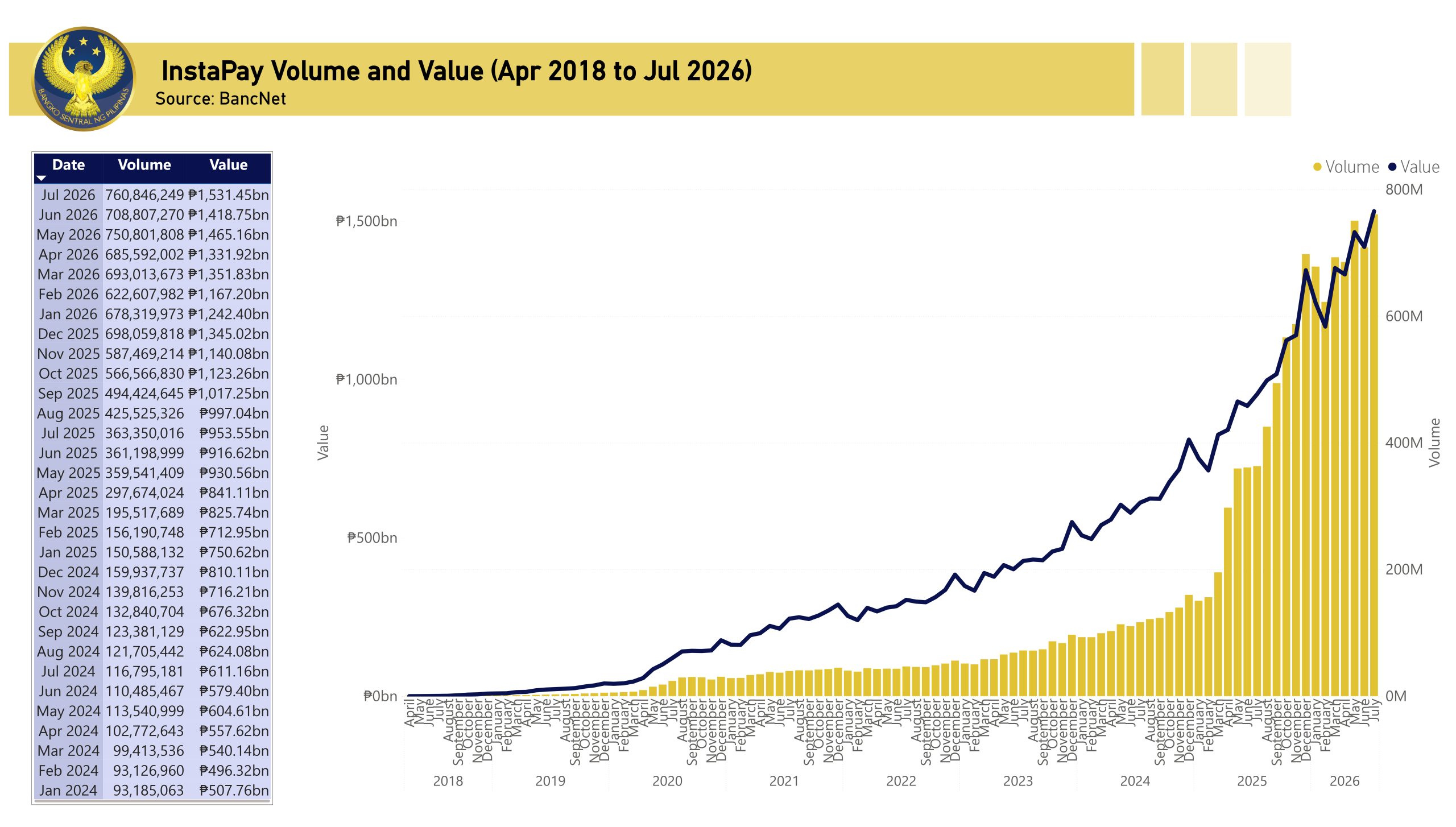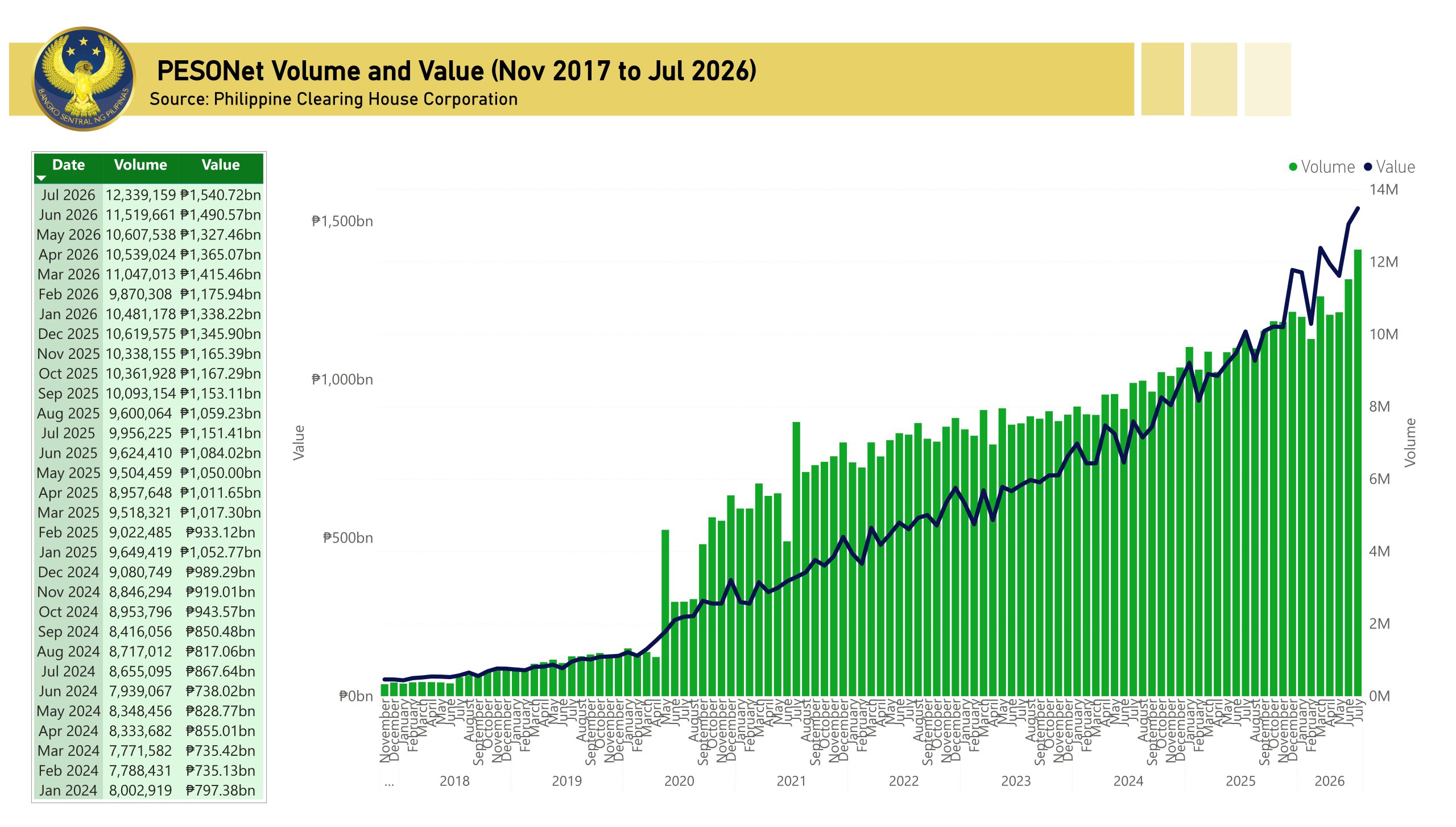
InstaPay and PESONet transactions hit record levels in July as banks began waiving or reducing online fund transfer fees in support of the Bangko Sentral ng Pilipinas’ push for wider digital payments adoption.
Preliminary data from the BSP showed transactions through the two payment systems jumped 46.2% in value to P3.07 trillion from P2.1 trillion a year earlier.
InstaPay transfers surged 60.4% to an all-time high of P1.53 trillion from P953.55 billion, while PESONet transactions climbed 33.9% to a record P1.54 trillion from P1.15 trillion.
Transaction volumes also increased sharply. The number of InstaPay transfers more than doubled to 760.85 million from 363.35 million, while PESONet transactions rose 23.9% to 12.34 million from 9.96 million.
The surge came as banks and other financial institutions started cutting or waiving transfer fees following new BSP rules aimed at making digital payments more affordable.
Under BSP Circular No. 1238, fees for transferring funds to another bank or electronic money issuer should not be materially different from those charged for transfers within the same institution.
Growth was also strong in the first seven months of 2026, with the combined value of InstaPay and PESONet transactions rising 44.7% to P19.15 trillion from P13.23 trillion a year earlier. Volume reached 4.97 billion transactions from 1.95 billion.
InstaPay accounted for P9.5 trillion of the seven-month total, up 60.2% from P5.93 trillion as volume surged 160.6% to 4.9 billion.
PESONet transfers, meanwhile, jumped 32.2% in value to P9.65 trillion from P7.3 trillion, while volume grew 15.3% to 76.4 million.
InstaPay, launched in 2018, is a real-time electronic fund transfer system for transactions of up to P50,000, while PESONet processes transfers in batches and has a higher limit of up to P500,000.
The BSP expects digital payment growth to continue as it rolls out measures to lower transaction costs and broaden access.
Digital payments accounted for 64.7% of total retail payment transactions in the Philippines in 2025, up from 57.4% in 2024 and within the government’s 60% to 70% target under the Philippine Development Plan for 2023-2028.
“The BSP continues to work closely with industry and government partners to expand digital payments to benefit more Filipinos and the economy as a whole,” BSP Governor Eli Remolona Jr. said.