
By Reuters
NEW YORK (Reuters) — The United States and China may be fighting for supremacy in artificial intelligence, but investors are not choosing sides.
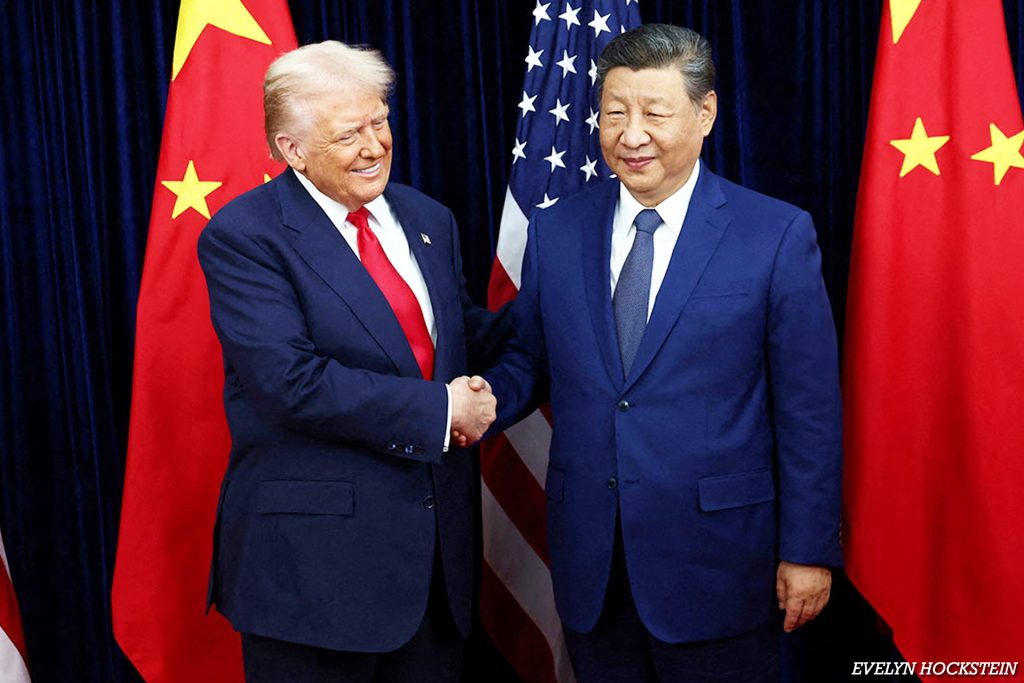
As US President Donald Trump and Chinese President Xi Jinping prepare to meet in Washington this week, American banks are helping Chinese AI and chip companies raise billions of dollars, while Chinese investors continue pouring money into US technology stocks.
Wall Street banks have served as bookrunners on 19 Chinese high-tech equity deals worth $17.2 billion so far this year, according to LSEG data. That is nearly 30% of all equity raised by the sector.
Money is moving the other way as well. US equities, particularly semiconductor stocks, are a favorite destination of Chinese funds, while US shares held by Hong Kong and mainland Chinese investors have risen 23% over the past year to more than $750 billion.
The cross-border bets show how difficult it is to financially separate the world’s two biggest economies even as Washington and Beijing try to build increasingly independent AI industries.
China is pursuing greater self-sufficiency in chips and AI, while Washington is building its own network through Pax Silica, a US-led initiative aimed at securing AI supply chains with trusted partners. The Philippines joined Pax Silica in January, putting Manila inside the emerging US-backed technology network.
The US has also restricted China’s access to advanced chips and chipmaking technology and curbed some American investments in sensitive Chinese technology.
Yet Wall Street remains deeply involved.
Goldman Sachs, Morgan Stanley and Citigroup were among the global coordinators for optical-parts maker Zhongji Innolight’s $6.8-billion Hong Kong listing. Goldman and Morgan Stanley also worked on listings by Chinese AI and semiconductor companies, while JPMorgan underwrote a roughly $2.6-billion share sale by printed-circuit-board maker Victory Giant Technology.
Chinese money is similarly chasing the American AI boom. US technology shares account for a large part of the roughly 1 trillion yuan, or $150 billion, managed by China’s outbound mutual funds.
Chinese holdings in US chipmakers including Micron Technology, AMD, Sandisk, Lam Research and Applied Materials have also increased this year, according to Sinolink Securities data.
US AI financing rounds involving investors based in China or Hong Kong reached about $8.9 billion through mid-September, according to S&P Global Market Intelligence, up sharply from $436 million in 2023.
The financial ties provide an important backdrop to the Trump-Xi meeting, where AI is expected to be among the major issues. US Treasury Secretary Scott Bessent and Chinese Vice Premier He Lifeng have already discussed establishing a US-China dialogue on AI risks.
But those investments could become vulnerable if relations deteriorate and Washington and Beijing push their technology industries further apart.
For now, investors appear unwilling to bet everything on either country.
“There probably won’t be a single winner in the U.S.-China AI race,” said Xile He, co-founder and CEO of San Francisco AI startup BrentX. “From an investor perspective, I think betting entirely on one side is a big risk.”
That leaves an unusual reality behind the AI rivalry: Washington and Beijing are trying to build separate technology worlds, while their investors keep putting money into both.—Reuters


