
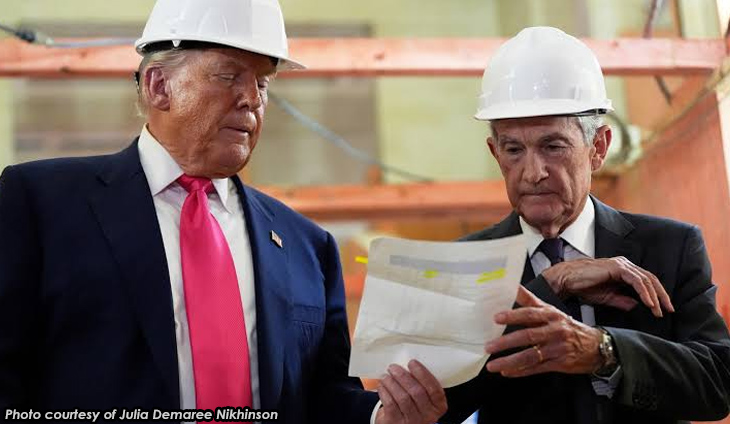
WASHINGTON (Reuters) — A US Federal Reserve watchdog found no evidence of criminal or administrative misconduct in a $2.4-billion renovation of the central bank’s Washington headquarters, but flagged weak oversight that contributed to roughly $1 billion in cost overruns.
The findings did little to end President Donald Trump’s long-running battle with former Fed chair Jerome Powell. Trump renewed his call for Powell, who remains a member of the Fed’s Board of Governors, to resign and said the government should consider suing him.
“At no point during our evaluation did we find reasonable grounds to believe that a violation of federal criminal law had occurred,” the Fed’s Office of Inspector General said.
The watchdog also said it found no administrative misconduct, although it identified shortcomings in the way the massive renovation was managed.
Trump has used the project’s rising cost as part of his criticism of Powell, whom he has repeatedly attacked over interest rates. Powell stepped down as Fed chair in May but remains a governor.
Trump nominated Powell to lead the central bank in 2017. Their relationship later soured as Trump pressed for lower borrowing costs.
“Too Late” Powell should resign from the Fed board, Trump said on Truth Social, arguing that he had failed to properly manage both the renovation and monetary policy. Trump said he had asked Attorney General Todd Blanche to review the inspector general’s report.
The dispute matters beyond the cost of renovating two historic buildings. It has become part of a broader debate over the independence of the Federal Reserve, whose interest-rate decisions ripple through global financial markets and influence borrowing costs and currencies, including in the Philippines.
Oversight failures
While clearing officials of misconduct, the inspector general was critical of how the renovation was managed.
The report found that better oversight could have reduced some of the cost overruns. One major problem involved what was supposed to be a “guaranteed maximum price” contract designed to shift responsibility for overruns to the contractor.
That maximum price was never actually established, according to the report. Project managers continued awarding subcontracts as costs and construction timelines increased.
Plumbing and air-conditioning costs alone eventually reached $346 million, about three times the initial estimate.
The watchdog also rejected claims that luxury features were a major reason for the ballooning budget. Design elements cited by White House critics, including marble, water features and a garden terrace, “did not materially contribute” to the overruns.
Powell had previously attributed much of the additional expense to construction complications, including asbestos removal, underground work and higher labor and material costs.
He declined to comment on the watchdog’s findings.
New Fed Chair Kevin Warsh, who succeeded Powell in May, said the central bank would implement the inspector general’s recommendations and hire an independent auditor to review costs already awarded.
Powell-Trump feud
The renovation became another front in Trump’s years-long campaign against Powell over US interest rates.
Tensions escalated in January when federal prosecutors issued subpoenas seeking information about the project and Powell’s testimony to Congress.
Powell publicly disclosed the threat of criminal charges and argued that the investigation was an attempt to pressure the Fed into cutting interest rates or force him from office.
A federal judge quashed the subpoenas in March, finding they were a pretext for pressuring Powell. The Justice Department investigation was subsequently closed and the matter referred to the Fed inspector general.
The watchdog’s findings drew sharply different reactions in Congress.
Republican Senator Tim Scott, chairman of the Senate Banking Committee, called the overruns “egregious” and promised continued oversight.
Democratic Senator Elizabeth Warren said the report showed there was “no basis to restart the president’s witch hunt” against Powell.
Powell has said he intends to remain on the Fed board until the investigation is fully resolved.
“I will not leave the Board until this investigation is well and truly over, with transparency and finality,” he said in April.


